Download Template Buku:

Indexed by


Panduan Penulisan
Surat Pernyataan Keaslian Karya Penulis & Contohnya (UNDUH)
Copyright and License
Download HKI (2023)
Download HKI (2024)

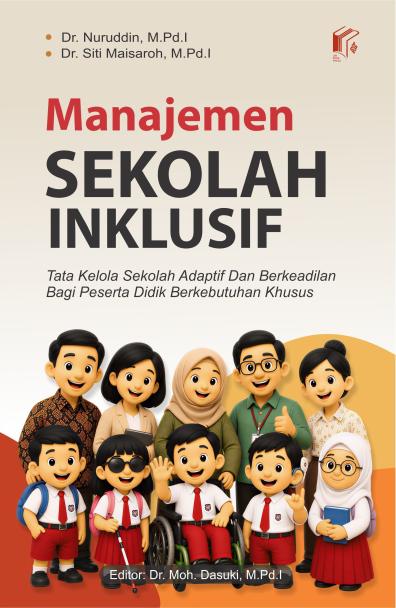
Pendidikan merupakan hak fundamental setiap warga negara sebagaimana diamanatkan dalam Undang-Undang Dasar Negara Republik Indonesia Tahun 1945. Dalam konteks tersebut, pendidikan inklusif menjadi salah satu strategi penting untuk memastikan bahwa setiap peserta didik, termasuk peserta didik berkebutuhan khusus, memperoleh kesempatan yang sama dalam mengakses layanan pendidikan yang bermutu. Pendidikan inklusif tidak hanya berbicara tentang membuka akses, tetapi juga tentang membangun lingkungan belajar yang menerima keberagaman, menghargai perbedaan, serta memberikan ruang bagi setiap peserta didik untuk berkembang sesuai dengan potensi dan kebutuhannya.
Keberhasilan penyelenggaraan sekolah inklusif sangat ditentukan oleh kualitas manajemen yang diterapkan. Sekolah dituntut mampu mengembangkan tata Kelola yang adaptif terhadap keragaman karakteristik peserta didik, membangun budaya organisasi yang inklusif, memperkuat kapasitas pendidik dan tenaga kependidikan, mengoptimalkan kemitraan dengan orang tua dan masyarakat, serta menyelenggarakan layanan Pendidikan yang berorientasi pada prinsip keadilan, kesetaraan, dan keberlanjutan. Oleh sebab itu, manajemen sekolah inklusif tidak dapat dipahami semata sebagai aktivitas administratif, melainkan sebagai proses strategis dalam menggerakkan seluruh sumber daya pendidikan untuk mewujudkan layanan pendidikan yang bermutu bagi semua.
Buku ini hadir sebagai jawaban atas kebutuhan akan literatur yang membahas pendidikan inklusif dari perspektif manajemen pendidikan. Melalui pembahasan yang sistematis, para penulis menguraikan berbagai aspek penting, mulai dari landasan filosofis dan regulative pendidikan inklusif, kepemimpinan sekolah, pengelolaan kurikulum dan pembelajaran, pengembangan sumber daya manusia, budaya sekolah, kemitraan dengan berbagai pemangku kepentingan, hingga sistem evaluasi dan penjaminan mutu sekolah inklusif. Dengan demikian, buku ini tidak hanya memperkaya khazanah keilmuan, tetapi juga menawarkan berbagai gagasan dan praktik yang dapat diimplementasikan oleh para pengelola lembaga pendidikan.
Ainscow, M. (2005). Developing inclusive education systems: What are the levers for change? Journal of Educational Change, *6*(2), 109–124. https://doi.org/10.1007/s10833-005-1298-4
Ainscow, M. (2020). Promoting inclusion and equity in education: Lessons from international experiences. Routledge.
Ainscow, M., & Sandill, A. (2010). Developing inclusive education systems: The role of organisational cultures and leadership. International Journal of Inclusive Education, *14*(4), 401–416. https://doi.org/10.1080/13603110802504903
Ainscow, M., Booth, T., & Dyson, A. (2006). Improving schools, developing inclusion. Routledge.
Alma Harris. (2014). Distributed leadership matters: Perspectives, practicalities, and potential. Corwin.
Amka. (2024). Manajemen pendidikan inklusif: Strategi menciptakan pendidikan bermutu untuk semua. Kencana.
Amstutz, L. S., & Mullet, J. H. (2005). The little book of restorative discipline for schools: Teaching responsibility; creating caring climates. Good Books.
Apple, M. W. (2013). Can education change society? Routledge.
Artiles, A. J., Kozleski, E. B., & Waitoller, F. R. (2011). Inclusive education: Examining equity on five continents. Harvard Education Press.
Bass, B. M., & Avolio, B. J. (1994). Improving organizational effectiveness through transformational leadership. Sage.
Bell, L. A. (Ed.). (2016). Teaching for diversity and social justice (3rd ed.). Routledge.
Berger, P. L., & Luckmann, T. (1966). The social construction of reality: A treatise in the sociology of knowledge. Anchor Books.
Bertalanffy, L. von. (1968). General system theory: Foundations, development, applications. George Braziller.
Black, P., & Wiliam, D. (2009). Developing the theory of formative assessment. Educational Assessment, Evaluation and Accountability, *21*(1), 5–31.
Booth, T., & Ainscow, M. (2011). Index for inclusion: Developing learning and participation in schools (3rd ed.). Centre for Studies on Inclusive Education.
Bruns, B., Filmer, D., & Patrinos, H. A. (2011). Making schools work: New evidence on accountability reforms. World Bank.
Budiyanto. (2017). Pengantar pendidikan inklusif berbasis budaya lokal. Prenadamedia Group.
Bush, T. (2020). Theories of educational leadership and management (5th ed.). SAGE Publications.
Caldwell, B. J. (2005). School-based management. UNESCO International Institute for Educational Planning.
Caldwell, B. J., & Spinks, J. M. (2013). The self-transforming school. Routledge.
Carol Ann Tomlinson. (2014). The differentiated classroom: Responding to the needs of all learners (2nd ed.). ASCD.
CAST. (2024). Universal Design for Learning Guidelines version 3.0. https://udlguidelines.cast.org
Cohen, J., McCabe, E. M., Michelli, N. M., & Pickeral, T. (2009). School climate: Research, policy, practice, and teacher education. Teachers College Record, *111*(1), 180–213.
Darling-Hammond, L., Hyler, M. E., & Gardner, M. (2017). Effective teacher professional development. Learning Policy Institute.
Darmaningtyas. (2017). Pendidikan yang memiskinkan. Intrans Publishing.
David Mitchell. (2015). Inclusive education is a multifaceted concept. Center for Educational Policy Studies Journal, *5*(1), 9–30.
DeMatthews, D., & Mawhinney, H. (2014). Social justice leadership and inclusion: Exploring challenges in an urban district struggling to address inequities. Educational Administration Quarterly.
Direktorat Pembinaan Pendidikan Khusus dan Layanan Khusus (PPKLK). (2018). Pedoman penyelenggaraan pendidikan inklusif. Kemendikbud.
Donald Schön. (1983). The reflective practitioner: How professionals think in action. Basic Books.
DuFour, R., & Eaker, R. (2008). Professional learning communities at work. Solution Tree Press.
Dyson, A. (2010). The development of inclusive schools: Three perspectives from England. Die Deutsche Schule, *102*(2), 115–129.
Dyson, A., Howes, A., & Roberts, B. (2004). A systematic review of the effectiveness of school-level actions for promoting participation by all students. EPPI-Centre.
Edmondson, A. (1999). Psychological safety and learning behavior in work teams. Administrative Science Quarterly, *44*(2), 350–383.
Edmondson, A. (2018). The fearless organization: Creating psychological safety in the workplace for learning, innovation, and growth. Wiley.
Epstein, J. L. (2011). School, family, and community partnerships: Preparing educators and improving schools (2nd ed.). Routledge.
Fattah, N. (2017). Landasan manajemen pendidikan. Remaja Rosdakarya.
Fidan, T., & Balcı, A. (2017). Managing schools as complex adaptive systems: A strategic perspective. International Electronic Journal of Elementary Education, *10*(1), 11–26. https://doi.org/10.26822/iejee.2017131883
Florian, L. (2014). What counts as evidence of inclusive education? European Journal of Special Needs Education, *29*(3), 286–294.
Florian, L., & Black-Hawkins, K. (2011). Exploring inclusive pedagogy. Cambridge Journal of Education, *41*(4), 495–510. https://doi.org/10.1080/0305764X.2011.625076
Fraser, N. (2008). Scales of justice: Reimagining political space in a globalizing world. Columbia University Press.
Freire, P. (1970). Pedagogy of the oppressed. Continuum.
Friend, M., & Cook, L. (2017). Interactions: Collaboration skills for school professionals (8th ed.). Pearson.
Fullan, M. (2016). The new meaning of educational change (5th ed.). Teachers College Press.
Fung, A. (2006). Varieties of participation in complex governance. Public Administration Review, *66*(s1), 66–75.
Garnida, D. (2015). Pengantar pendidikan inklusif. Refika Aditama.
Hall, T. E., Meyer, A., & Rose, D. H. (2012). Universal design for learning in the classroom: Practical applications. Guilford Press.
Hallinger, P. (2011). Leadership for learning: Lessons from 40 years of empirical research. Journal of Educational Administration, *49*(2), 125–142. https://doi.org/10.1108/09578231111116699
Hargreaves, A. (2001). Emotional geographies of teaching. Teachers College Record, *103*(6), 1056–1080. https://doi.org/10.1111/0161-4681.00142
Hargreaves, A., & Fullan, M. (2012). Professional capital: Transforming teaching in every school. Teachers College Press.
Hehir, T. (2005). New directions in special education: Eliminating ableism in policy and practice. Harvard Education Press.
Helen Timperley. (2011). Realizing the power of professional learning. McGraw-Hill Education.
Howley, A., Faiella, C. M., Kroeger, S. D., & Hansen, B. (2020). Inclusive education: A systematic perspective. Information Age Publishing (IAP).
Hoy, W. K., & Miskel, C. G. (2013). Educational administration: Theory, research, and practice (9th ed.). McGraw-Hill.
James P. Spillane. (2006). Distributed leadership. Jossey-Bass.
Johnson, D. W., & Johnson, R. T. (2009). An educational psychology success story: Social interdependence theory and cooperative learning. Educational Researcher, *38*(5), 365–379.
Kementerian Pendidikan Nasional. (2009). Peraturan Menteri Pendidikan Nasional Nomor 70 Tahun 2009 tentang Pendidikan Inklusif bagi Peserta Didik yang Memiliki Kelainan dan Memiliki Potensi Kecerdasan dan/atau Bakat Istimewa.
Kementerian Pendidikan, Kebudayaan, Riset, dan Teknologi. (2022). Profil Pelajar Pancasila.
Kenneth Leithwood, & Jantzi, D. (2006). Transformational school leadership for large-scale reform: Effects on students, teachers, and their classroom practices. School Effectiveness and School Improvement, *17*(2), 201–227.
Kenneth Leithwood, Harris, A., & Hopkins, D. (2020). Seven strong claims about successful school leadership revisited. School Leadership & Management, *40*(1), 5–22. https://doi.org/10.1080/13632434.2019.1596077
Ketikidou, G., & Saiti, A. (2022). The promotion of inclusive education through sustainable and systemic leadership. International Journal of Leadership in Education.
Khalifa, M. (2020). Culturally responsive school leadership. Harvard Education Press.
Kotter, J. P. (2012). Leading change (Rev. ed.). Harvard Business Review Press.
Levin, H. M. (2003). Making education a public responsibility. Education Policy Analysis Archives.
Lindsey, D. B., Thousand, J. S., Jew, C. L., & Piowlski, L. R. (2018). Culturally proficient inclusive schools: All means ALL! (2nd ed.). Corwin Press.
Loreman, T. (2017). Pedagogy for inclusive education. Oxford Research Encyclopedia of Education.
Lorian, L. (Ed.). (2014). The SAGE handbook of special education (2nd ed.). SAGE Publications.
Meyer, A., Rose, D. H., & Gordon, D. (2014). Universal design for learning: Theory and practice. CAST Professional Publishing.
Michael Fullan. (2020). Leading in a culture of change (2nd ed.). Jossey-Bass.
Mitchell, D. (2015). Inclusive education is a multi-faceted concept. Routledge.
Moraca, J. (2025). Integrating social justice in educational management: A systematic review. Lex Localis – Journal of Local Self-Government.
Morrison, B. (2007). Restoring safe school communities: A whole school response to bullying, violence and alienation. Federation Press.
Morrison, B., & Vaandering, D. (2012). Restorative justice: Pedagogy, praxis, and discipline. Journal of School Violence, *11*(2), 138–155. https://doi.org/10.1080/15388220.2011.653322
Mudjito, Harizal, & Elfindri. (2012). Pendidikan inklusif. Baduose Media.
Mulyasa, E. (2013). Manajemen berbasis sekolah. Remaja Rosdakarya.
Mulyasa, E. (2021). Manajemen dan kepemimpinan kepala sekolah. Bumi Aksara.
Mulyasa, E. (2023). Implementasi kurikulum merdeka. Bumi Aksara.
Neves, C., Almeida, A. P., & Ferreira, M. (2023). Headteachers and inclusion: Setting the tone for an inclusive school. Education Sciences, *13*(2), Article 129. https://doi.org/10.3390/educsci13020129
OECD. (2017). Education policy outlook: Indonesia. OECD Publishing.
OECD. (2018). The future of education and skills: Education 2030. OECD Publishing.
OECD. (2020). Education policy outlook 2020: Shaping responsive and resilient education in a changing world. OECD Publishing.
Peter Senge. (2006). The fifth discipline: The art and practice of the learning organization.
Pidarta, M. (2011). Manajemen pendidikan Indonesia. Rineka Cipta.
Pressman, J. L., & Wildavsky, A. (1984). Implementation: How great expectations in Washington are dashed in Oakland (3rd ed.). University of California Press.
Rawls, J. (1971). A theory of justice. Harvard University Press.
Rentzi, A. (2024). Social justice in education: Creating an inclusive culture at schools through critical multicultural theory. European Journal of Education and Pedagogy.
Rohiat. (2020). Manajemen sekolah: Teori dasar dan praktik. Refika Aditama.
Rose, D. H., & Meyer, A. (2002). Teaching every student in the digital age: Universal design for learning. ASCD.
Ryan, J. (2006). Inclusive leadership and social justice for schools. Leadership and Policy in Schools, *5*(1), 3–17. https://doi.org/10.1080/15700760500483995
Schein, E. H. (2010). Organizational culture and leadership (4th ed.). Jossey-Bass.
Schön, D. A. (1983). The reflective practitioner: How professionals think in action. Basic Books.
Senge, P. M. (2006). The fifth discipline: The art and practice of the learning organization (Rev. ed.). Doubleday.
Sergiovanni, T. J., & Starratt, R. J. (2007). Supervision: A redefinition (8th ed.). McGraw-Hill.
Shaeffer, S. (2019). Inclusive education: A prerequisite for equity and social justice. Asia Pacific Education Review.
Simplican, S. C., Leader, G., Kosciulek, J., & Leahy, M. (2015). Defining social inclusion of people with intellectual and developmental disabilities. Journal of Policy and Practice in Intellectual Disabilities, *12*(3), 179–187.
Simplican, S. C., Leader, G., Kosciulek, J., & Leahy, M. (2015). Defining social inclusion of people with intellectual and developmental disabilities. Research in Developmental Disabilities, *38*, 18–29. https://doi.org/10.1016/j.ridd.2014.10.008
Slee, R. (2011). The irregular school: Exclusion, schooling and inclusive education. Routledge.
Slee, R. (2018). Inclusive education isn’t dead, it just smells funny. Routledge.
Spencer-Iiams, J., & Flosi, J. (2020). Leading for all: How to create truly inclusive and excellent schools. Corwin Press.
Stoll, L., Bolam, R., McMahon, A., Wallace, M., & Thomas, S. (2006). Professional learning communities: A review of the literature. Journal of Educational Change, *7*(4), 221–258. https://doi.org/10.1007/s10833-006-0001-8
Strike, K. A., & Soltis, J. F. (2009). The ethics of teaching (5th ed.). Teachers College Press.
Stufflebeam, D. L., & Zhang, G. (2017). The CIPP evaluation model: How to evaluate for improvement and accountability. Guilford Press.
Sunanto, J. (2009). Pendidikan inklusif dan implementasinya. UPI Press.
Suryosubroto, B. (2018). Manajemen pendidikan di sekolah. Rineka Cipta.
Terzi, L. (2008). Justice and equality in education: A capability perspective on disability and special educational needs. Continuum.
Thapa, A., Cohen, J., Guffey, S., & Higgins-D’Alessandro, A. (2013). A review of school climate research. Review of Educational Research, *83*(3), 357–385.
Tilaar, H. A. R. (2012). Manajemen pendidikan nasional. Remaja Rosdakarya.
Tilaar, H.A.R. (2012). Perubahan sosial dan pendidikan. Rineka Cipta.
Tomlinson, C. A. (2014). The differentiated classroom: Responding to the needs of all learners (2nd ed.). ASCD.
Undang-Undang Republik Indonesia Nomor 20 Tahun 2003 tentang Sistem Pendidikan Nasional.
UNESCO. (1994). The Salamanca Statement and Framework for Action on Special Needs Education. UNESCO.
UNESCO. (2020). Global Education Monitoring Report 2020: Inclusion and education – All means all. UNESCO.
UNICEF. (2021). Seen, counted, included: Using data to shed light on the well-being of children with disabilities. UNICEF.
United Nations. (2006). Convention on the Rights of Persons with Disabilities. https://www.un.org/disabilities/documents/convention/convention_accessible_pdf.pdf
Vaandering, D. (2010). The significance of critical theory for restorative justice in education. Review of Education, Pedagogy, and Cultural Studies, *32*(2), 145–176.
Valdés, R., Gómez-Hurtado, I., Coronel, J. M., & Améstica, J. (2026). School leadership for inclusive education: Theoretically relevant dimensions for its development. Education Inquiry.
Vygotsky, L. S. (1978). Mind in society: The development of higher psychological processes. Harvard University Press.
Waldron, N. L., & McLeskey, J. (2010). Establishing a collaborative school culture through comprehensive school reform. Journal of Educational and Psychological Consultation.
World Bank. (2018). World development report 2018: Learning to realize education’s promise. World Bank.
World Health Organization. (2011). World report on disability. WHO.
Wubbels, T., Den Brok, P., van Tartwijk, J., & Levy, J. (2015). Interpersonal relationships in education. Springer.
Ydo, Y. (2020). Inclusive education: Global priority, collective responsibility. Prospects, *49*(3–4), 97–101. https://doi.org/10.1007/s11125-020-09520-y
Yuval-Davis, N. (2006). Belonging and the politics of belonging. Patterns of Prejudice, *40*(3), 197–214.

This work is licensed under a Creative Commons Attribution-ShareAlike 4.0 International License.
Download Template Buku:
Indexed by
Panduan Penulisan
Surat Pernyataan Keaslian Karya Penulis & Contohnya (UNDUH)
Copyright and License
Download HKI (2023)
Download HKI (2024)
Mailing Address and Principle Contact
Jl. Mataram No.1, Kelurahan Mangli,
Kecamatan Kaliwates, Kabupaten Jember,
Jawa Timur 68136
website: https://press.uinkhas.ac.id
e-mail: uinkhaspress@uinkhas.ac.id / uinkhaspress@gmail.com
Telp: (0331) 487550
Ponsel: +62 823-3760-5983
This work is licensed under a Creative Commons Attribution-ShareAlike 4.0 International License.
