Download Template Buku:

Indexed by


Panduan Penulisan
Surat Pernyataan Keaslian Karya Penulis & Contohnya (UNDUH)
Copyright and License
Download HKI (2023)
Download HKI (2024)

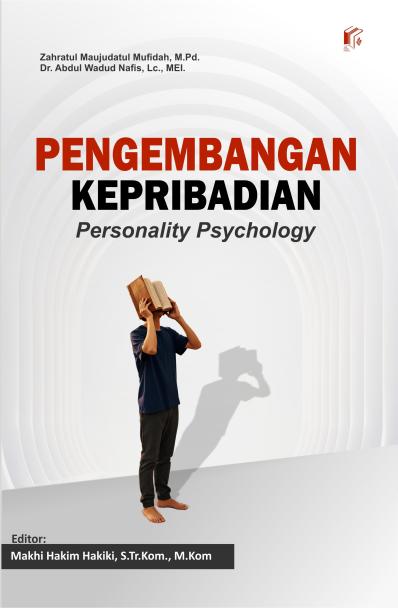
Konsep kepribadian merupakan konstruk sentral dalam psikologi yang telah mengalami evolusi pemahaman yang signifikan seiring perkembangan paradigma keilmuan. Secara etimologis, istilah "kepribadian" berasal dari kata Latin persona, yang merujuk pada topeng yang digunakan para aktor dalam pertunjukan teater Romawi kuno, yang kemudian berkembang menjadi konsep tentang diri yang ditampilkan kepada dunia (Funder, 2019). Dalam psikologi modern, kepribadian umumnya didefinisikan sebagai pola khas dari pikiran, perasaan, dan perilaku yang membedakan satu individu dengan individu lainnya, serta konsistensi pola tersebut sepanjang waktu dan situasi (Larsen et al., 2017). Definisi ini menekankan pada dua aspek fundamental: keunikan individu (individual differences) dan kestabilan relatif dari pola-pola psikologis tersebut.
Bandura, A. (2018). Toward a psychology of human agency: Pathways and reflections. Perspectives on Psychological Science, 13(2), 130-136.
Baumeister, R. F., & Vohs, K. D. (2018). Strength model of self-regulation as limited resource: Assessment, controversies, update. In Advances in experimental social psychology (Vol. 58, pp. 67-127). Academic Press.
Cervone, D., & Pervin, L. A. (2019). Personality: Theory and research (14th ed.). Wiley.
Diener, E., Lucas, R. E., & Oishi, S. (2018). Advances and open questions in the science of subjective well-being. Collabra: Psychology, 4(1), 15.
Fowers, B. J. (2018). Character, virtue, and science: Interpreting positive psychology. In N. E. Snow (Ed.), The Oxford handbook of virtue (pp. 525-548). Oxford University Press.
Funder, D. C. (2019). The personality puzzle (8th ed.). W. W. Norton & Company.
Haidt, J., & Kesebir, S. (2019). Morality. In S. T. Fiske, D. T. Gilbert, & G. Lindzey (Eds.), Handbook of social psychology (5th ed., Vol. 2, pp. 797-832). John Wiley & Sons.
Jensen-Campbell, L. A., & Malcolm, K. T. (2019). The importance of agreeableness in interpersonal relationships. In The Oxford handbook of psychological situations (pp. 295-310). Oxford University Press.
Larsen, R. J., Buss, D. M., Wismeijer, A., & Song, J. (2017). Personality psychology: Domains of knowledge about human nature (6th ed.). McGraw-Hill Education.
McCrae, R. R., & Costa, P. T. (2018). Introduction to the empirical and theoretical status of the five-factor model of personality traits. In Personality disorders and the five-factor model of personality (3rd ed., pp. 15-27). American Psychological Association.
Mischel, W., & Shoda, Y. (2019). The cognitive-affective processing system (CAPS): A dynamic framework for understanding personality and individual differences. In The Oxford handbook of psychological situations (pp. 193-212). Oxford University Press.
Ryff, C. D., & Singer, B. H. (2018). Know thyself and become what you are: A eudaimonic approach to psychological well-being. In The exploration of happiness (pp. 97-116). Springer.
Savickas, M. L. (2019). Career construction theory and practice. In Career development and counseling: Putting theory and research to work (3rd ed., pp. 165-200). John Wiley & Sons.
Turkle, S. (2017). Alone together: Why we expect more from technology and less from each other (3rd ed.). Basic Books.
Twenge, J. M. (2020). Why increases in adolescent depression may be linked to the technological environment. Current Opinion in Psychology, 32, 89-94.
World Economic Forum. (2020). The future of jobs report 2020. World Economic Forum.

This work is licensed under a Creative Commons Attribution-ShareAlike 4.0 International License.
Download Template Buku:
Indexed by
Panduan Penulisan
Surat Pernyataan Keaslian Karya Penulis & Contohnya (UNDUH)
Copyright and License
Download HKI (2023)
Download HKI (2024)
Mailing Address and Principle Contact
Jl. Mataram No.1, Kelurahan Mangli,
Kecamatan Kaliwates, Kabupaten Jember,
Jawa Timur 68136
website: https://press.uinkhas.ac.id
e-mail: uinkhaspress@uinkhas.ac.id / uinkhaspress@gmail.com
Telp: (0331) 487550
Ponsel: +62 823-3760-5983
This work is licensed under a Creative Commons Attribution-ShareAlike 4.0 International License.
