Download Template Buku:

Indexed by


Panduan Penulisan
Surat Pernyataan Keaslian Karya Penulis & Contohnya (UNDUH)
Copyright and License
Download HKI (2023)
Download HKI (2024)

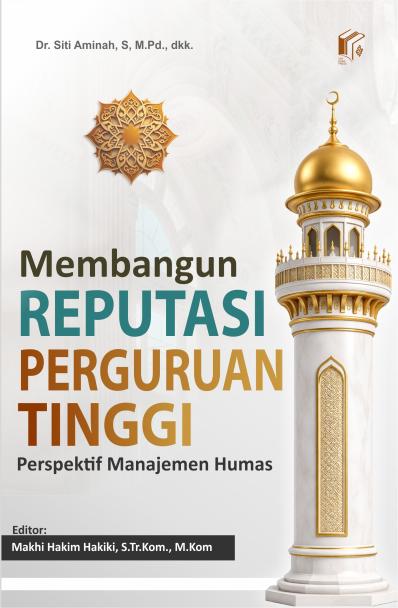
Perguruan tinggi Islam menghadapi perubahan lingkungan Pendidikan yang ditandai oleh perkembangan teknologi, meningkatnya persaingan, perubahan kebutuhan masyarakat, dan keterbukaan informasi. Kondisi tersebut menuntut perguruan tinggi tidak hanya memperkuat kualitas akademik, tetapi juga mengembangkan komunikasi strategis, hubungan dengan stakeholder, dan kepercayaan publik. Dalam konteks ini, manajemen hubungan masyarakat (humas) memiliki peran penting dalam membangun dan menjaga reputasi institusi.
Buku Membangun Reputasi Perguruan Tinggi Islam: Perspektif Manajemen Humas membahas pengelolaan humas sebagai bagian dari strategi kelembagaan. Pembahasan mencakup transformasi pendidikan tinggi, identitas dan posisi institusi, manajemen humas, strategi komunikasi, relasi stakeholder, komunikasi digital, citra dan reputasi, hingga pengukuran kinerja kehumasan. Seluruh pembahasan diarahkan untuk menunjukkan keterkaitan antara komunikasi, kualitas hubungan, dan kinerja nyata perguruan tinggi.
Buku ini menempatkan humas bukan sekadar sebagai pelaksana publikasi, melainkan sebagai fungsi strategis yang membantu institusi memahami kebutuhan publik, mengelola informasi, membangun kolaborasi, serta merespons isu dan perubahan lingkungan. Melalui pendekatan tersebut, reputasi dipahami sebagai hasil dari konsistensi antara identitas, komunikasi, dan pengalaman nyata stakeholder.
Agusdinata, D. B. (2022). The role of universities in SDGs solution co-creation and implementation: A human-centered design and shared-action learning process. Sustainability Science, 17(4), 1589–1604. https://doi.org/10.1007/s11625-022-01128-9
Al-Dmour, R., Al-Dmour, H., Iskandrani, M., & Al-Dmour, A. (2025). The impact of digital transformation on the reputation of public higher education institutions in Jordan. SAGE Open, 15(4). https://doi.org/10.1177/21582440251390962
Amado Mateus, M. A., & Juarez Acosta, F. J. (2022). Reputation in higher education: A systematic review. Frontiers in Education, 7, Article 925117. https://doi.org/10.3389/feduc.2022.925117
Amalia, V. (2020). Strategi komunikasi humas dalam meningkatkan public trust di perguruan tinggi (Studi kasus di Universitas Nurul Jadid, Paiton, Probolinggo). Al-Tanzim: Jurnal Manajemen Pendidikan Islam, 4(1). https://doi.org/10.33650/al-tanzim.v4i1.812
AMEC. (n.d.). AMEC Integrated Evaluation Framework. https://amecorg.com/amecframework/
An empirical model of university competitiveness and rankings: The effects of entrepreneurial behaviors and dynamic capabilities. (2024). Asia Pacific Management Review. https://doi.org/10.1016/j.apmrv.2023.04.005
Asfia, N., & Sari, E. A. (2024). Higher education crisis communication in Indonesia in the digital era for maintaining reputation. INJECT (Interdisciplinary Journal of Communication), 9(2), 221–260. https://doi.org/10.18326/inject.v9i2.2386
Azhary, S. (2020). Strategi pemeliharaan relasional dalam kegiatan public relations online badan publik di Indonesia. PRofesi Humas, 4(2), 193–214. https://jurnal.unpad.ac.id/profesi-humas/issue/view/1392
Basori, A. R., Nugraha, M. S., Asiah, A., & Hayat, A. B. (2026). Integrasi need assessment dan key performance indicators dalam penjaminan mutu pendidikan tinggi Islam: Systematic literature review. TSAQAFATUNA: Jurnal Ilmu Pendidikan Islam, 8(1), 159–180. https://doi.org/10.54213/tsaqafatuna.v8i1.858
Bidandi, F., Anthony, A. N., & Mukong, C. (2022). Collaboration and partnerships between South African higher education institutions and stakeholders: Case study of a post-apartheid university. Discover Education, 1, Article 2. https://doi.org/10.1007/s44217-022-00001-2
Capriotti, P., & Zeler, I. (2023). Analysing effective social media communication in higher education institutions. Humanities and Social Sciences Communications, 10, Article 656. https://doi.org/10.1057/s41599-023-02187-8
Christiyanto, T., Munandar, A., & Hilmi. (2026). Strategic public relations management: Bridging madrasas and external stakeholders for educational excellence. Al-Tanzim: Jurnal Manajemen Pendidikan Islam, 10(2). https://doi.org/10.33650/al-tanzim.v10i2.14157
Coombs, W. T. (2007). Protecting organization reputations during a crisis: The development and application of situational crisis communication theory. Corporate Reputation Review, 10(3), 163–176. https://doi.org/10.1057/palgrave.crr.1550049
D’Oria, L., Crook, T. R., Ketchen, D. J., Sirmon, D. G., & Wright, M. (2021). The evolution of resource-based inquiry: A review and meta-analytic integration of the strategic resources–actions–performance pathway. Journal of Management, 47(6), 1383–1429. https://doi.org/10.1177/0149206321994182
de Groot, L., Demeijer, F. A., Zweekhorst, M., & Urias, E. (2025). Multi-stakeholder networks in the higher education context: A configurative literature review of university-community interactions. Journal of Higher Education Policy and Management, 47(4), 490–508. https://doi.org/10.1080/1360080X.2025.2451445
Fauzi, A., Sanjani, M. A. F., Zaini, A. W., & Haty, M. L. (2025). The influence of social media on public relations as a reinforcement of higher education reputation. Managere: Indonesian Journal of Educational Management, 7(1). https://doi.org/10.52627/managere.v7i1.650
Fombrun, C. J. (1996). Reputation: Realizing value from the corporate image. Harvard Business School Press.
Freeman, R. E. (1984). Strategic management: A stakeholder approach. Pitman.
Freire, B. D., Conejero, M. A., & Parente, T. C. (2021). Saliência, influência e participação dos stakeholders nas estruturas de governança e no processo de tomada de decisão de instituições públicas de ensino superior. Revista Gestão Universitária na América Latina - GUAL. https://doi.org/10.5007/1983-4535.2021.e80297
García-Rodríguez, F. J., & Gutiérrez-Taño, D. (2024). Loyalty to higher education institutions and the relationship with reputation: An integrated model with multi-stakeholder approach. Journal of Marketing for Higher Education, 34(1), 223–245. https://doi.org/10.1080/08841241.2021.1975185
Gibbons, M., Limoges, C., Nowotny, H., Schwartzman, S., Scott, P., & Trow, M. (1994). The new production of knowledge: The dynamics of science and research in contemporary societies. SAGE Publications.
González-Pérez, M. A., Córdova, M., Hermans, M., Nava-Aguirre, K. M., Monje-Cueto, F., Mingo, S., Tobón, S., Rodríguez, C. A., Salvaj, E., & Floriani, D. E. (2021). Crises conducting stakeholder salience: Shifts in the evolution of private universities’ governance in Latin America. Corporate Governance: The International Journal of Business in Society. https://doi.org/10.1108/CG-09-2020-0397
Goodman, H. P., Yow, R., Standberry-Wallace, M., Dekom, R., Harper, M., Nieto Gomez, A., & Watson, A. D. (2023). Perspectives from community partnerships in three diverse higher education contexts. Gateways: International Journal of Community Research and Engagement, 16(2). https://doi.org/10.5130/ijcre.v16i2.8693
Gregory, A. (2020). The fundamentals of measurement and evaluation of communication. In V. Luoma-aho & M.-J. Canel (Eds.), The handbook of public sector communication. Wiley. https://doi.org/10.1002/9781119263203.ch24
Grunig, J. E. (2006). Furnishing the edifice: Ongoing research on public relations as a strategic management function. Journal of Public Relations Research, 18(2), 151–176. https://doi.org/10.1207/s1532754xjprr1802_5
Grunig, J. E., & Hunt, T. (1984). Managing public relations. Holt, Rinehart and Winston.
Hallahan, K., Holtzhausen, D., van Ruler, B., Verčič, D., & Sriramesh, K. (2007). Defining strategic communication. International Journal of Strategic Communication, 1(1), 3–35. https://doi.org/10.1080/15531180701285244
Hamdani, N. A. (2023). Scrutinizing Islamic higher education institutions in Indonesia. Jurnal Pendidikan Islam, 9(1), 79–92. https://doi.org/10.15575/jpi.v0i0.24478
Hart, P. F., & Rodgers, W. (2024). Competition, competitiveness, and competitive advantage in higher education institutions: A systematic literature review. Studies in Higher Education, 49(11), 2153–2177. https://doi.org/10.1080/03075079.2023.2293926
Hendrawati, T. (2026). Transforming learning organization systems for sustainable innovation in Islamic private universities. Edukasi Islami: Jurnal Pendidikan Islam, 15(1). https://doi.org/10.30868/ei.v15i01.10037
Hermita, M., Hermana, B., Harmanto, S., Suhendra, A., & Pasaribu, M. (2023). Social media engagement and students’ intention in Indonesian higher education using Unified Theory of Acceptance and Use of Technology. MATRIK: Jurnal Manajemen, Teknik Informatika dan Rekayasa Komputer, 22(3), 605–614.
Hidayat, R. (2021). Manajemen pemasaran pendidikan. Komojoyo Press.
Hon, L. C., & Grunig, J. E. (1999). Guidelines for measuring relationships in public relations. Institute for Public Relations.
Hong, S., Kim, B., & Lee, S. Y. (2023). A public health crisis in the university: Impact of crisis response strategies on universities’ transparency and post-crisis relationships during COVID-19 pandemic. Public Relations Review, 49(1), Article 102287. https://doi.org/10.1016/j.pubrev.2023.102287
Indriani, I., & Syamsudin, S. (2023). Manajemen public relation dan strategi lembaga pendidikan Islam dalam membangun citra lembaga. Indonesian Journal of Educational Management and Leadership, 1(1), 106–117. https://doi.org/10.51214/ijemal.v1i1.531
Islam, K., Edwards, A. L., Shi, D., Lim, J. K. R., Sheppard, R., Liu, B. F., & Seeger, M. W. (2022). Crisis communication and learning: The US higher education’s response to a global pandemic. The Learning Organization, 29(4), 357–376. https://doi.org/10.1108/TLO-10-2021-0121
Jain, V., Mogaji, E., Sharma, H., & Babbili, A. S. (2024). A multi-stakeholder perspective of relationship marketing in higher education institutions. Journal of Marketing for Higher Education, 34(2), 502–520. https://doi.org/10.1080/08841241.2022.2034201
Juhaidi, A. (2024). Social media marketing of Islamic higher education institution in Indonesia: A marketing mix perspective. Cogent Business & Management, 11(1), Article 2374864. https://doi.org/10.1080/23311975.2024.2374864
Kementerian Agama Republik Indonesia. (2019). Al-Qur’an dan terjemahannya: Edisi penyempurnaan 2019. Lajnah Pentashihan Mushaf Al-Qur’an.
Kent, M. L., & Taylor, M. (2002). Toward a dialogic theory of public relations. Public Relations Review, 28(1), 21–37. https://doi.org/10.1016/S0363-8111(02)00108-X
Khairiah, K., Irsal, I., & Yunilarosi, E. S. (2025). Challenges in institutional accreditation management (AIPT) and its ineffectiveness in improving the quality of Islamic higher education in Indonesia. Asian Journal of Human Services, 29, 338–352. https://doi.org/10.14391/ajhs.29.338
Khanna, K. (2023). Building students’ attachment strength with higher education institutes using intangible resources: Role of institutional branding. Higher Education, Skills and Work-Based Learning, 13(3), 528–559. https://doi.org/10.1108/HESWBL-03-2023-0076
Kotler, P., & Keller, K. L. (2016). Marketing management (15th ed.). Pearson.
Lakhno, M. (2024). Green or green-washed? Examining sustainability reporting in higher education. Higher Education Quarterly, 78(3), 1099–1122. https://doi.org/10.1111/hequ.12513
Langrafe, T. de F., Barakat, S. R., Stocker, F., & Boaventura, J. M. G. (2020). A stakeholder theory approach to creating value in higher education institutions. The Bottom Line, 33(4), 297–313. https://doi.org/10.1108/BL-03-2020-0021
Latif, K. F., Tariq, R., Muneeb, D., Farooq, U., & Ahmad, S. (2024). University social responsibility and performance: The role of service quality, reputation, student satisfaction and trust. Journal of Marketing for Higher Education, 34(2), 967–991. https://doi.org/10.1080/08841241.2022.2139791
Law, S. F., & Le, A. T. (2023). A systematic review of empirical studies on trust between universities and society. Journal of Higher Education Policy and Management, 45(4), 393–408. https://doi.org/10.1080/1360080X.2023.2176598
Lee, S. J. (2022). Similarities and differences in image projection of Korean universities across institutional types: A text mining analysis of university president messages. International Journal of Chinese Education. https://doi.org/10.1177/2212585X221140680
Littleton, C., Townsin, L., & Beilby, J. (2023). The motivations of stakeholders when developing university industry collaborations in an Australian university: Three case studies. Journal of Higher Education Policy and Management, 45(5), 481–494. https://doi.org/10.1080/1360080X.2023.2191608
Liu, B. F., Shi, D., Lim, J. R., Islam, K., Edwards, A. L., & Seeger, M. (2022). When crises hit home: How U.S. higher education leaders navigate values during uncertain times. Journal of Business Ethics, 179, 353–368. https://doi.org/10.1007/s10551-021-04820-5
Macnamara, J. (2018). Evaluating public communication: Exploring new models, standards, and best practice. Routledge. https://doi.org/10.4324/9781315391984
Macnamara, J. (2023). Evaluating public communication: Exploring new models, standards, and best practice. Routledge.
Majid, A., Wahyuni, H. I., Abrar, A. N., & Fitrah, A. A. (2025). Systematic review of university public relations communication strategies: 2010–2022. PRofesi Humas, 10(1). https://doi.org/10.24198/prh.v10i1.56522
Maulana, A. E., Patterson, P. G., Satria, A., & Pradipta, I. A. (2024). Alumni connectedness and its role in intention to contribute to higher education institutions. Journal of Marketing for Higher Education, 34(2), 1124–1145. https://doi.org/10.1080/08841241.2023.2186560
Men, L. R., & Hung, C.-J. F. (2012). Exploring the roles of organization-public relationships in the strategic management process: Towards an integrated framework. International Journal of Strategic Communication, 6(2), 151–173. https://doi.org/10.1080/1553118X.2011.605778
Miotto, G., Del-Castillo-Feito, C., & Blanco-González, A. (2020). Reputation and legitimacy: Key factors for higher education institutions’ sustained competitive advantage. Journal of Business Research, 112, 342–353. https://doi.org/10.1016/j.jbusres.2019.11.076
Munandar, D., Ananda, F. R., Syaifuddin, S., Lubis, Y., & Nasib, N. (2022). The role of student trust in mediating service quality and student reputation against e-WOM. Journal of Educational Science and Technology, 8(2). https://doi.org/10.26858/est.v8i2.36669
Nsanzumuhire, S. U., & Groot, W. (2020). Context perspective on university-industry collaboration processes: A systematic review of literature. Journal of Cleaner Production, 258, Article 120861. https://doi.org/10.1016/j.jclepro.2020.120861
Oakland, J. S. (2014). Total quality management and operational excellence: Text with cases (4th ed.). Routledge.
Oktivera, E., Wirawan, F. A. W., & Jaya, A. S. (2024). Pemilihan media sosial dalam pemenuhan informasi memilih perguruan tinggi. Jurnal Audiens, 5(1), 127–139. https://doi.org/10.18196/jas.v5i1.347
Pohlenz, P., Berndt, S., & Hartmann, J. (2025). University networks for higher education quality development: Between mutual trust and control. Higher Education Policy, 38, 600–618. https://doi.org/10.1057/s41307-024-00362-3
Porter, M. E. (1980). Competitive strategy: Techniques for analyzing industries and competitors. Free Press.
Prabawangi, R. P., Fatanti, M. N., & Nasih, A. M. (2026). Student information preferences and the role of social media in Indonesian higher education. PRofesi Humas, 10(2), 191–214. https://doi.org/10.24198/prh.v10i2.58978
Qurniawati, E. F., Mardani, P. B., & Wulandari, H. (2024). The circular model of “SOME” on digital public relations management of Universitas Islam Riau. PRofesi Humas, 8(2).
Rachman, P., Abidin, M., Soleh, M. A. K., & Murfi, A. (2025). Balanced reputation management strategy: A cross-site case study of branding image for competitive advantage in Indonesian Islamic higher education institutions. Jurnal Pendidikan Islam, 14(1), 15–34. https://doi.org/10.14421/jpi.2025.141.15-34
Rosilawati, Y., & Winarsih, A. S. (2023). Crisis communication during COVID-19 pandemic: Lessons from Universitas Muhammadiyah Yogyakarta. Jurnal Ilmu Komunikasi, 21(2), 267–282. https://doi.org/10.31315/jik.v21i2.8422
Sanders, J. S., & Wong, T. (2021). International partner selection among higher education institutions in Hong Kong, Singapore and Japan: A resource-based view. Journal of Higher Education Policy and Management, 43(2), 214–229. https://doi.org/10.1080/1360080X.2020.1804658
Satlita, L. (2015). Manajemen kehumasan di perguruan tinggi. Efisiensi: Kajian Ilmu Administrasi, 7(1). https://doi.org/10.21831/efisiensi.v7i1.3911
Schäfer, M. S., Volk, S. C., Fürst, S., & Vogler, D. (2024). “It’s not so easy to measure impact”: A qualitative analysis of how universities measure and evaluate their communication. International Journal of Strategic Communication, 18(2), 93–114. https://doi.org/10.1080/1553118X.2024.2317771
Senge, P. M. (2006). The fifth discipline: The art and practice of the learning organization (Rev. ed.). Doubleday.
Serna, L. R., Nakandala, D., & Bowyer, D. (2022). Stakeholder identification and prioritization: The attribute of dependency. Journal of Business Research, 148, 444–455. https://doi.org/10.1016/j.jbusres.2022.04.062
Setiawan, D., Hidayatullah, Zulfikar, T., & Patimah, S. (2026). Building learning organizations in Islamic universities: Reflections on governance and knowledge ecology at Nahdlatul Ulama University Indonesia. Tadbiruna, 6(1), 274–286. https://doi.org/10.51192/jurnalmanajemenpendidikanislam.v6i1.2859
Setiawati, W., Erwina, W., & Perbawasari, S. (2022). Digital branding Kantor Arsip Universitas Padjadjaran dalam upaya penguatan reputasi. PRofesi Humas, 6(2), 243–266. https://doi.org/10.24198/prh.v6i2.35902
Setyanto, Y., Dida, S., & Novianti, E. (2025). Public relations as managerial function in university management. Jurnal Komunikasi, 17(1), 221–231. https://doi.org/10.24912/jk.v17i1.33884
Shihab, M. Q. (2002). Tafsir Al-Mishbah: Pesan, kesan, dan keserasian Al-Qur’an. Lentera Hati.
Silverman, D. A., & Smith, R. D. (2024). Strategic planning for public relations (7th ed.). Routledge. https://www.routledge.com/Strategic-Planning-for-Public-Relations/Silverman-Smith/p/book/9781032391168
Snijders, I., Wijnia, L., Kuiper, R. M., Rikers, R. M. J. P., & Loyens, S. M. M. (2022). Relationship quality in higher education and the interplay with student engagement and loyalty. British Journal of Educational Psychology, 92(2), 425–446. https://doi.org/10.1111/bjep.12455
Sroka, W., & Szántó, R. (2022). Building and rebuilding trust in higher education institutions (HEIs). Student’s perspective. Journal of Organizational Change Management, 35(6), 887–915. https://doi.org/10.1108/JOCM-02-2022-0037
Stakeholder engagement in higher education: State of the art and research agenda. (2024). IEEE Transactions on Engineering Management, 71, 13457–13468. https://doi.org/10.1109/TEM.2022.3218286
Stoica, D., Patriche, C.-C., David, S., Beldiman, C. M., & Dragomir Bălănică, C. M. (2025). Knowledge-driven reputation management in higher education institutions. Journal of Innovation & Knowledge, 10(6), Article 100811. https://doi.org/10.1016/j.jik.2025.100811
Stolze, A., & Sailer, K. (2022). Advancing HEIs’ third-mission through dynamic capabilities: The role of leadership and agreement on vision and goals. The Journal of Technology Transfer, 47, 580–604. https://doi.org/10.1007/s10961-021-09850-9
Sulistyaningtyas, I. D. (2007). Peran strategis public relations di perguruan tinggi. Jurnal Ilmu Komunikasi, 4(2). https://doi.org/10.24002/jik.v4i2.223
Visser, M. W., Demeijer, F. A., Zweekhorst, M. B. M., & Pittens, C. A. C. M. (2026). Navigating multi-stakeholder networks: Embracing diverse perspectives in higher education–community collaboration. Journal of Higher Education Policy and Management. Advance online publication. https://doi.org/10.1080/1360080X.2026.2622139
Wahib, A. (2021). Penguatan manajemen madrasah menuju madrasah berprestasi. Bildung Nusantara.
Warits, A., Husnayain, M. F., Imaduddin, I., Paisun, P., & Azis, A. (2026). Bibliometric analysis of quality assurance in Indonesian Islamic higher education: Mapping the knowledge landscape and policy implications. Nidhomul Haq: Jurnal Manajemen Pendidikan Islam, 11(1), 94–109. https://doi.org/10.31538/ndhq.v11i1.350
Wilson, L. J. (1992). Strategic program planning. Public Relations Review, 18(1), 9–15. https://doi.org/10.1016/0363-8111(92)90017-S
Xiao, Y., Nguyen, T. T. H., Nguyen, H. N., & Phan, D. Q. (2023). University brand: A systematic literature review. Heliyon, 9(6), Article e16825. https://doi.org/10.1016/j.heliyon.2023.e16825
Zipparo, J. (2023). The determinants of university strategic positioning and the obscuring of institutional diversity: An Australian case study. Tertiary Education and Management, 29, 341–364. https://doi.org/10.1007/s11233-022-09097-5

This work is licensed under a Creative Commons Attribution-ShareAlike 4.0 International License.
Download Template Buku:
Indexed by
Panduan Penulisan
Surat Pernyataan Keaslian Karya Penulis & Contohnya (UNDUH)
Copyright and License
Download HKI (2023)
Download HKI (2024)
Mailing Address and Principle Contact
Jl. Mataram No.1, Kelurahan Mangli,
Kecamatan Kaliwates, Kabupaten Jember,
Jawa Timur 68136
website: https://press.uinkhas.ac.id
e-mail: uinkhaspress@uinkhas.ac.id / uinkhaspress@gmail.com
Telp: (0331) 487550
Ponsel: +62 823-3760-5983
This work is licensed under a Creative Commons Attribution-ShareAlike 4.0 International License.
